Keep intelligence close to the person it serves

Why local, sovereign, and personal?

The case for running more of your personal AI on hardware you control—without pretending that “local” automatically means private, sustainable, resilient, or authorized.

Explore the four advantages ↓ See practical hardware

Public educational guide · No login · No PHI · No clinical or institutional authorization

The equipment concept

A local AI workstation inside a governed boundary

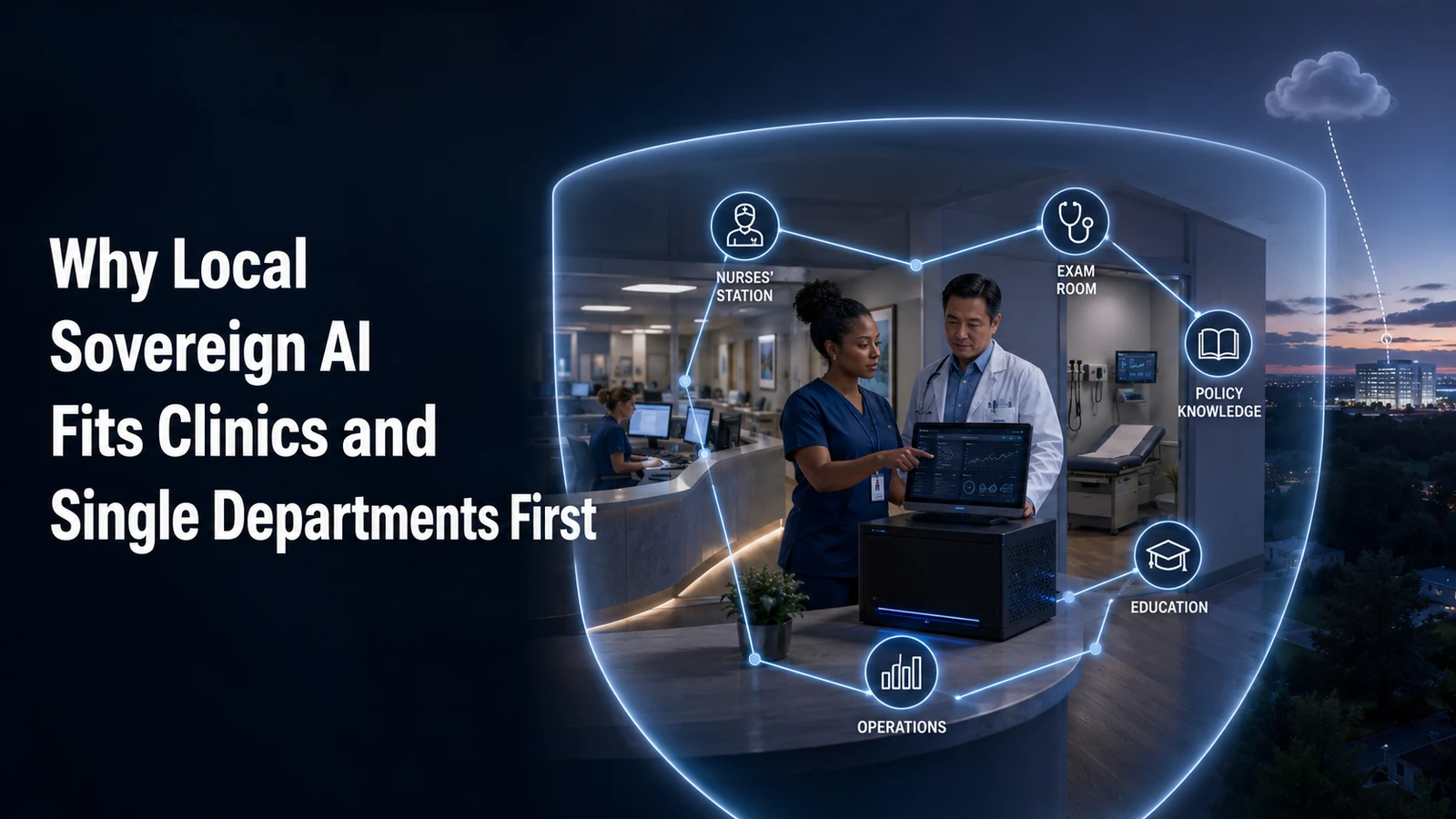
This is the architecture drawing at the center of the idea: nurse-facing equipment close to the work, with local compute, explicit domain connections, and cloud access kept optional rather than assumed.

Concept drawing of a local sovereign AI installation for a clinic: a nurse and physician use a laptop positioned on a local edge server, linked inside a glowing boundary to the nurses' station, exam room, policy knowledge, education, and operations, with an optional cloud outside the clinic.
Your original equipment concept drawing. Illustrative architecture—not evidence of an installed clinic system, clinical validation, PHI authorization, or institutional deployment.
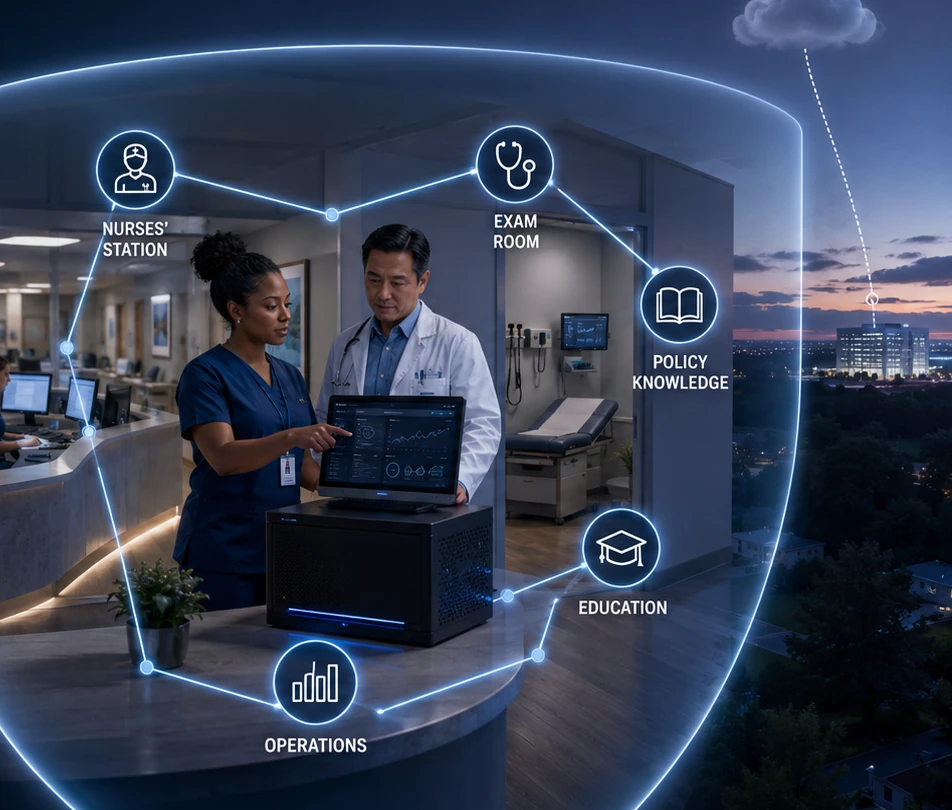
Detail of the concept equipment: laptop on a compact local AI server used by a nurse and physician, connected to nurses' station, exam room, policy knowledge, education, and operations inside a bounded clinic network.

What the drawing is showing

  • Local edge equipment: a compact server or workstation beneath the laptop.
  • Human control: a nurse and physician remain at the point of review.
  • Bounded connections: nursing station, exam room, policy, education, and operations are visible domains—not automatic permissions.
  • Optional cloud: outside the local boundary and used only through a deliberate governed path.

Important: the image is conceptual. Real equipment selection, network design, privacy, security, clinical use, and institutional integration require separate engineering and authorization.

Four connected advantages

Sovereignty, sustainability, and uptime can reinforce one another

The value of local AI is not that every task must run locally. The value is having a governed local path when privacy, continuity, cost control, or provider independence matters.

1. Data sovereignty

When inference, memory, logs, and files remain local—and cloud fallback is disabled—sensitive personal material does not need to transit a third-party model provider.

  • You control storage, retention, backup, and deletion.
  • Your personal context can remain outside provider training and retention paths.
  • Fewer processors can reduce the privacy and breach surface.

Boundary: hardware ownership alone is not enough. Browsers, telemetry, connectors, plugins, and fallback models may still transmit data.

2. Environmental choice

Right-sized local models on hardware already in use can avoid some marginal cloud demand for routine work. They can also make energy and hardware choices visible to the person using them.

415 → 945 TWh IEA estimate for global data-centre electricity consumption from 2024 to 2030.

Honest caveat: local is not automatically greener. Hyperscale systems may be more efficient per request because of batching and infrastructure efficiency. Compare the actual workload, hardware, energy mix, and equipment lifecycle.

3. Provider-outage resilience

A local model and local files can keep bounded workflows available when a model provider, API, identity service, CDN, or shared cloud dependency is unavailable.

  • No provider rate limit for work that stays on-device.
  • Local workflows can survive model retirement or pricing changes.
  • You can preserve a known working model and workflow version.

A Cloudflare configuration failure in November 2025 caused widespread network and authentication failures—an example of how shared infrastructure can become a common point of failure.

4. Grid and connectivity resilience

Laptop-class systems can continue for a bounded period on battery and can be paired with a UPS or other backup power. A smaller local model may preserve essential personal workflows when cloud access is unavailable.

11 hours Average U.S. customer electricity-interruption duration in 2024, with major events accounting for most of the total.

Boundary: local AI is not an emergency or clinical continuity system. Battery duration, hardware reliability, backups, and recovery procedures still require testing.

The sovereignty test

Local hardware is only the beginning

A system is meaningfully sovereign only when the person can inspect and control the full path—not merely the location of the computer.

Local inference is explicit

The selected model runs on the owned device, and any cloud fallback is visible, optional, and off by default.

Memory and logs remain controlled

Prompts, outputs, embeddings, logs, indexes, and backups have declared storage and deletion rules.

Tools use least privilege

Connectors and agents can reach only the files, applications, and actions explicitly approved for the workflow.

Models and workflows are portable

The person can export their files, configuration, evaluation records, and working state without depending on one vendor.

Updates remain reviewable and reversible

Model, prompt, tool, and policy changes are versioned, evaluated, and capable of rollback.

Human accountability remains intact

The system proposes and supports. It does not inherit licensure, professional authority, community mandate, or institutional permission.

Choose by workload, not ideology

A hybrid design is often the honest answer

PathStrongest fitPrimary tradeoff
LocalPrivate files, persistent personal context, offline continuity, predictable bounded workloads.Hardware limits, model quality, maintenance, energy use, and local security responsibility.
CloudFrontier capability, large context, multimodal work, rapid model upgrades, collaboration.Provider dependence, policy changes, retention settings, connectivity, and recurring cost.
Governed hybridLocal-first routine work with deliberate escalation to an approved cloud model for tasks that earn it.More architecture and testing; routing must never silently expand data exposure or authority.
Nurse AI OS boundary: Community and Personal Edition remain no-PHI and nonclinical whether the model is local or cloud-hosted. Local deployment alone does not establish HIPAA compliance, clinical validity, institutional authorization, cybersecurity assurance, or professional scope.

Environmental context

Water and energy impacts depend on design and place

Data-centre water demand varies significantly by cooling design, climate, location, power source, and workload. EESI reports that large facilities can consume up to five million gallons per day and cites an average water-usage-effectiveness figure of 1.9 litres per kWh across data centres.

Those figures should not be converted into a universal “water per AI prompt” claim. A responsible comparison asks what hardware already exists, how often it will run, how the grid is powered, how cooling works, whether equipment is being purchased unnecessarily, and whether a smaller model can perform the task.

The goal is not cloud rejection. It is the freedom to place each workload where its privacy, capability, resilience, and environmental requirements are best met.

Practical next step

Start with one local-safe workflow

Do not buy hardware first. Choose one no-PHI workflow—personal learning notes, a private project ledger, or a local document search—and prove that local operation adds enough privacy, continuity, or control to justify the added setup.

Review hardware and honest costs → Explore the local-model guide

Evidence ledger

Sources and limitations

These sources support the public figures and incident examples on this page. They do not establish that every local system is private, sustainable, resilient, secure, compliant, or suitable for healthcare.