Own your compute. Keep the engineering honest.

Your personal AI datacenter

Five illustrated hardware concepts—from a desk-sized dual-GPU workstation to an eight-GPU rack node—recovered from Robert Domondon’s original design portfolio.

See the five concepts ↓ Why local and sovereign?

Concept portfolio · No login · Draft specifications · Not a validated BOM, build guide, or purchase recommendation

The recovered design set

Five scales of local AI compute

The numbers below are transcribed and normalized from the original concept sheet. GPU memory and bandwidth use current NVIDIA per-card figures, multiplied only to describe installed capacity—not a single pooled memory space or guaranteed linear performance.

Do not build from this page alone. Chassis, lane topology, cooling, transient power, connector limits, circuit capacity, noise, structural load, drivers, model compatibility, and safety have not been independently engineered or validated.
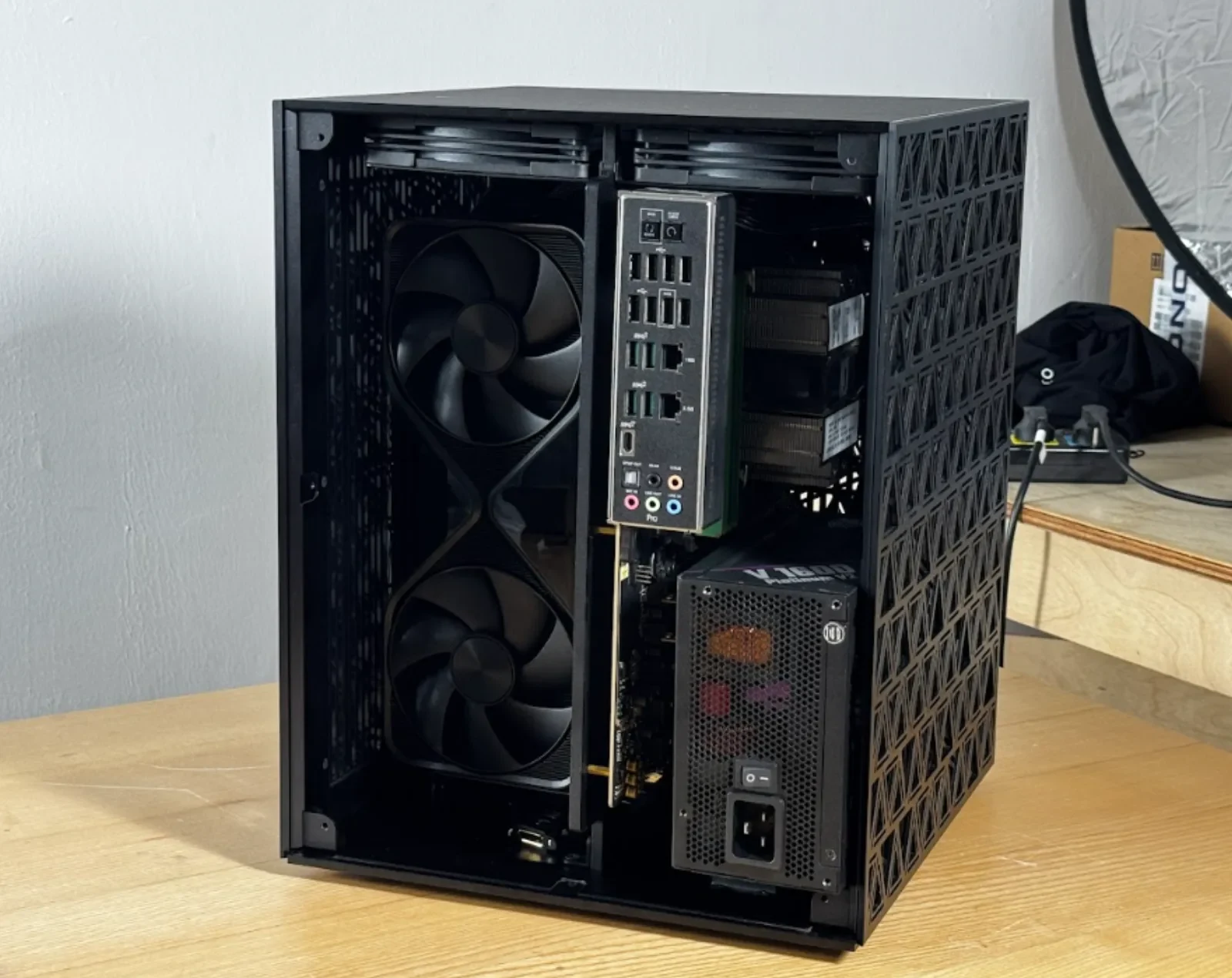
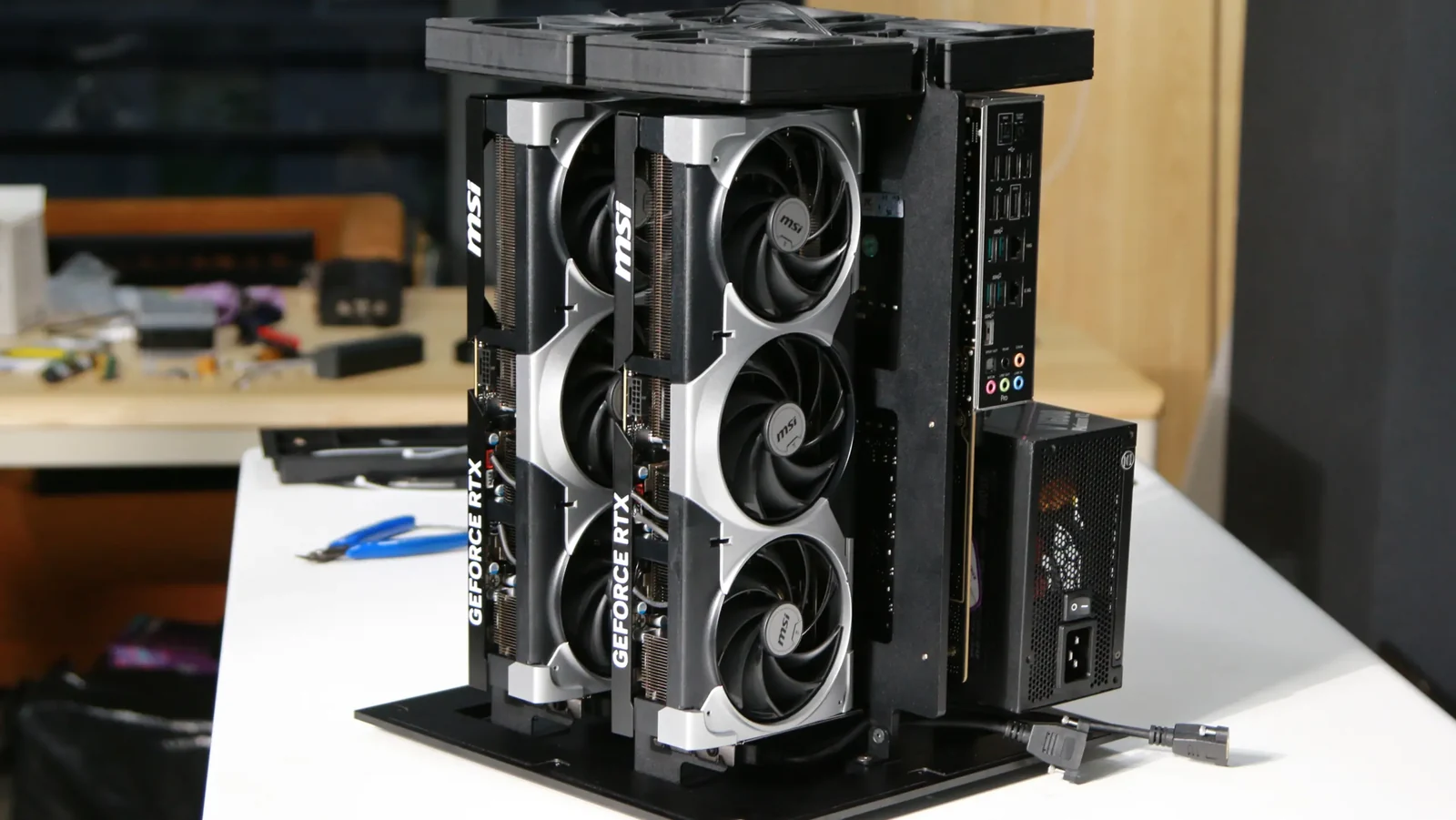
Open-frame concept computer with two vertically mounted NVIDIA GeForce RTX 5090-class graphics cards, compact motherboard, power supply, and top-mounted fans.

2× NVIDIA GeForce RTX 5090

Personal concept

Desk-sized local inference for quantized open models, private development, and sustained personal-agent workflows.

Installed GPU memory
64 GB GDDR7
Nominal aggregate bandwidth
3,584 GB/s
Draft host
Intel Xeon W5 · ASUS W790 ACE
System memory / storage
96 GB RAM · 1 TB NVMe
Draft networking
10 GbE + 2.5 GbE
Concept envelope
1,550 W · 12.5 × 12.5 × 16 in · 33 lb

Each RTX 5090 is specified by NVIDIA with 32 GB GDDR7 and 1,792 GB/s bandwidth. Multi-GPU model support, memory sharding, power, and thermal behavior depend on the software and final engineering.
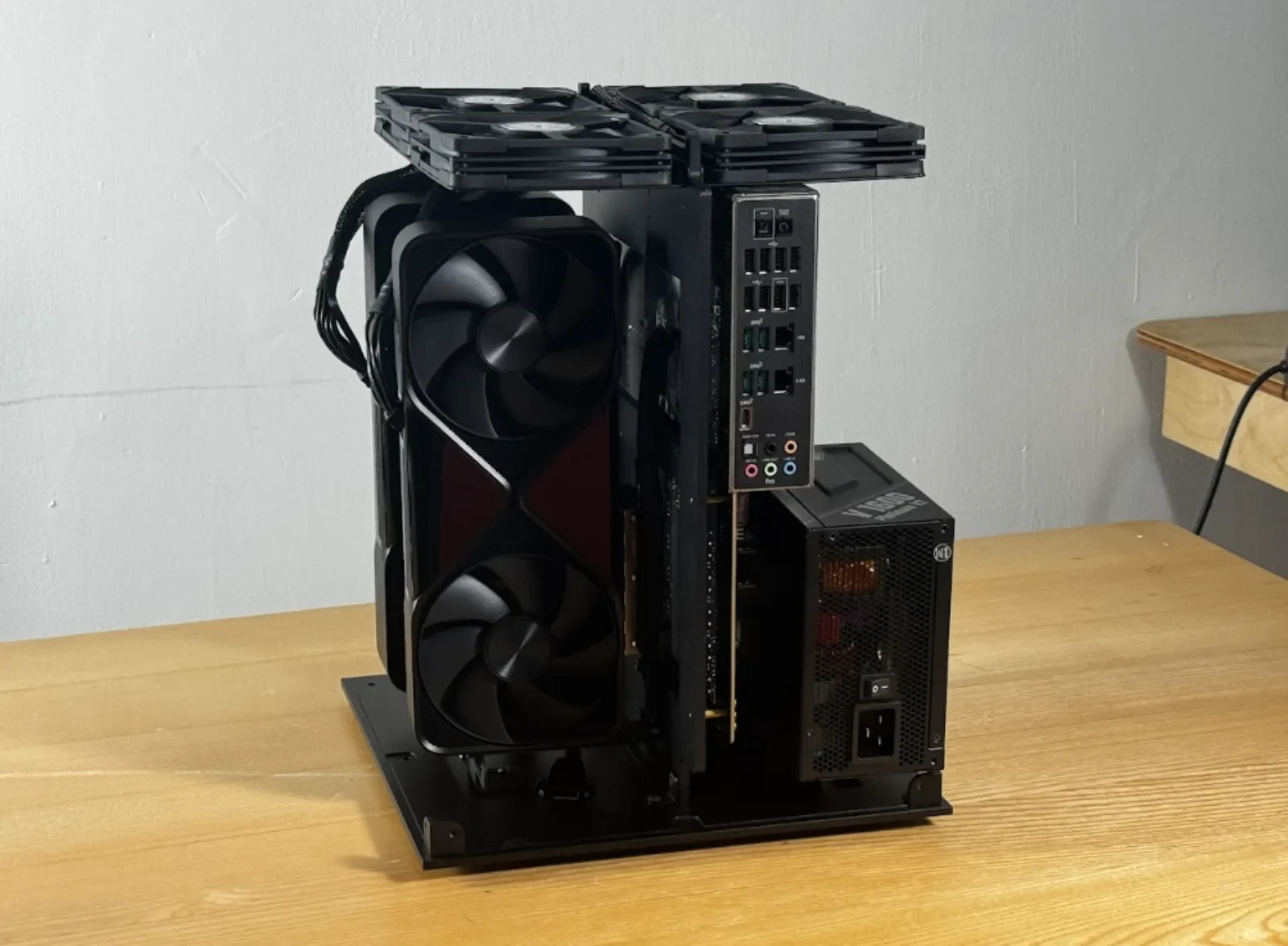
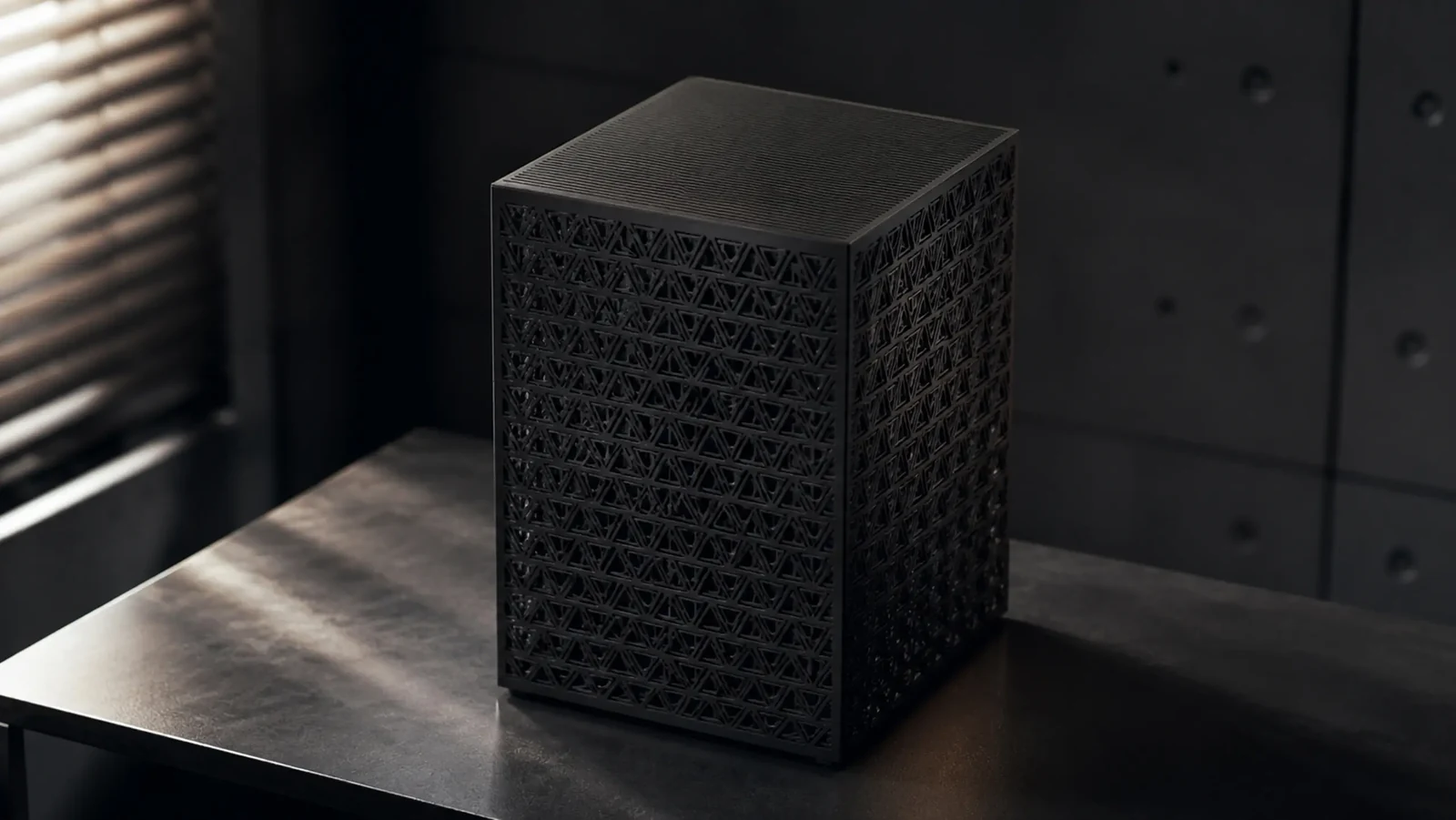
Open dual-GPU professional workstation concept with two large vertically mounted cards, central cooling fan, motherboard ports, and a compact power supply. Enclosed black cube concept for the dual NVIDIA RTX PRO 6000 workstation, with geometric ventilation panels.

2× NVIDIA RTX PRO 6000 Blackwell

High-memory personal concept

The same desk-oriented idea with ECC GPU memory for larger local models and professional workloads.

Installed GPU memory
192 GB GDDR7 ECC
Nominal aggregate bandwidth
About 3.6 TB/s
Draft host
Intel Xeon W5 · ASUS W790 ACE
System memory / storage
96 GB RAM · 1 TB NVMe
Draft networking
10 GbE + 2.5 GbE
Concept envelope
1,600 W · 12.5 × 12.5 × 16 in · 33 lb

NVIDIA specifies 96 GB GDDR7 ECC and approximately 1.8 TB/s bandwidth per RTX PRO 6000 Blackwell Workstation Edition. The exact card edition, cooling design, slot spacing, and power limits must be fixed before engineering the enclosure.

Enclosed tower concept for a four-GPU RTX 5090 local AI system, showing two large vertical intake fans, rear I/O, power supply, drive bays, and ventilated side panels.

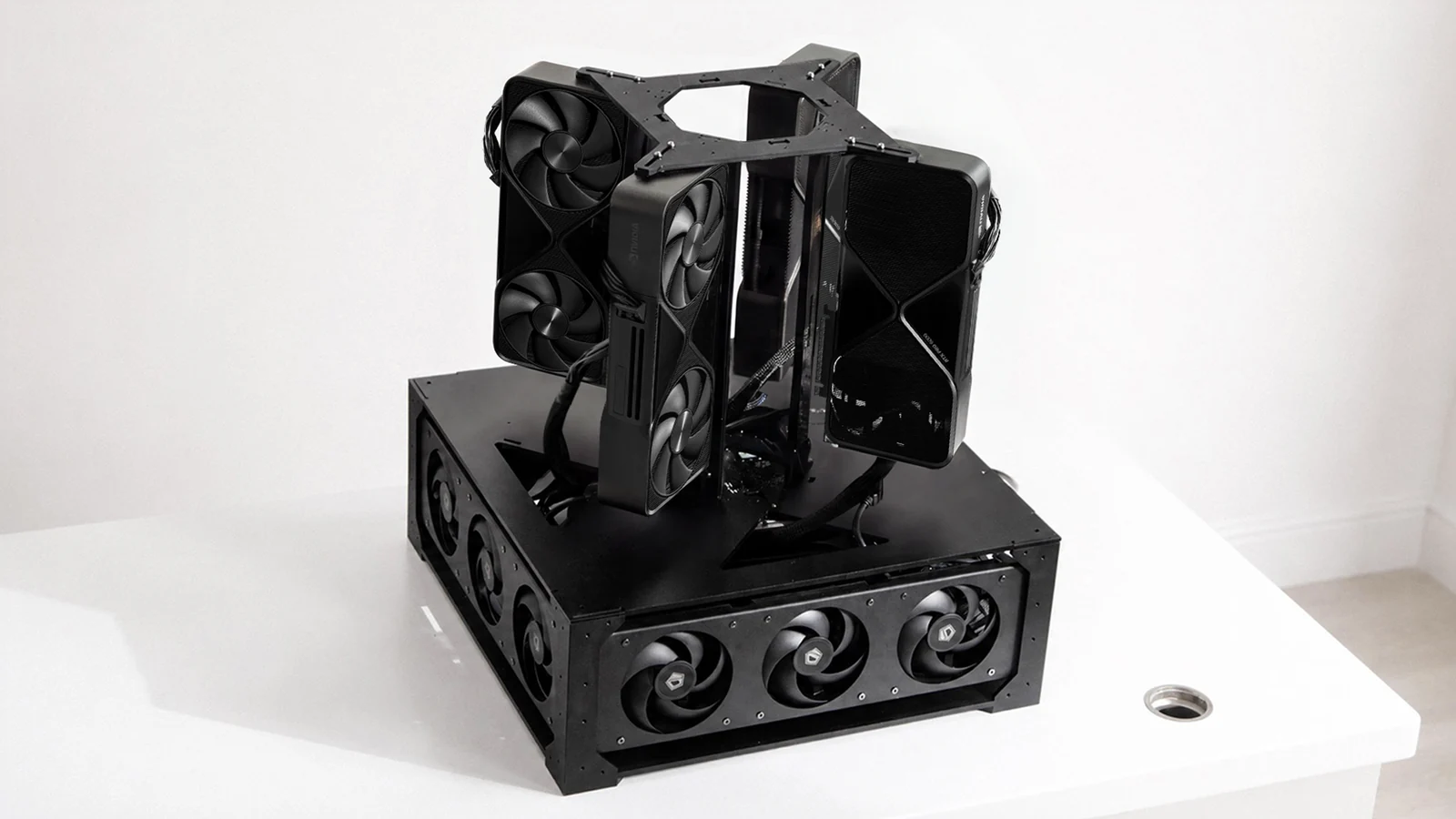
4× NVIDIA GeForce RTX 5090

Team concept

A larger local node for a small team developing and serving open models without making a cloud API the only path.

Installed GPU memory
128 GB GDDR7
Nominal aggregate bandwidth
7,168 GB/s
Draft host
AMD Ryzen Threadripper Pro
System memory / storage
96 GB RAM · 1 TB NVMe
Draft networking
2× 10 GbE · BMC
Concept envelope
2,750 W · 20 × 20 × 24 in · 66 lb

Four physical RTX 5090 cards create major lane, clearance, cooling, connector, and transient-load constraints. The drawing is an enclosure concept—not proof that reference cards fit or operate safely in this geometry.

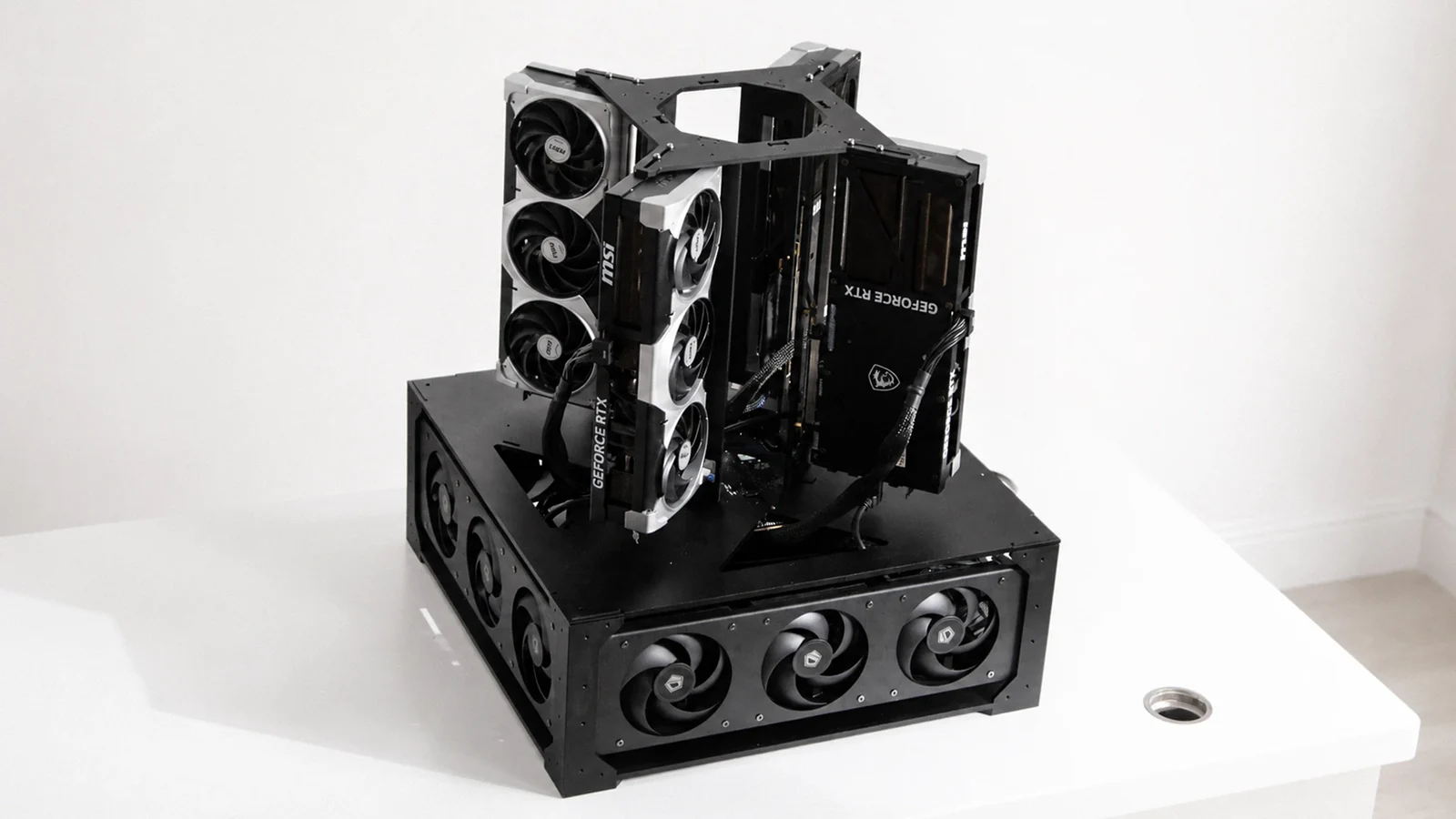
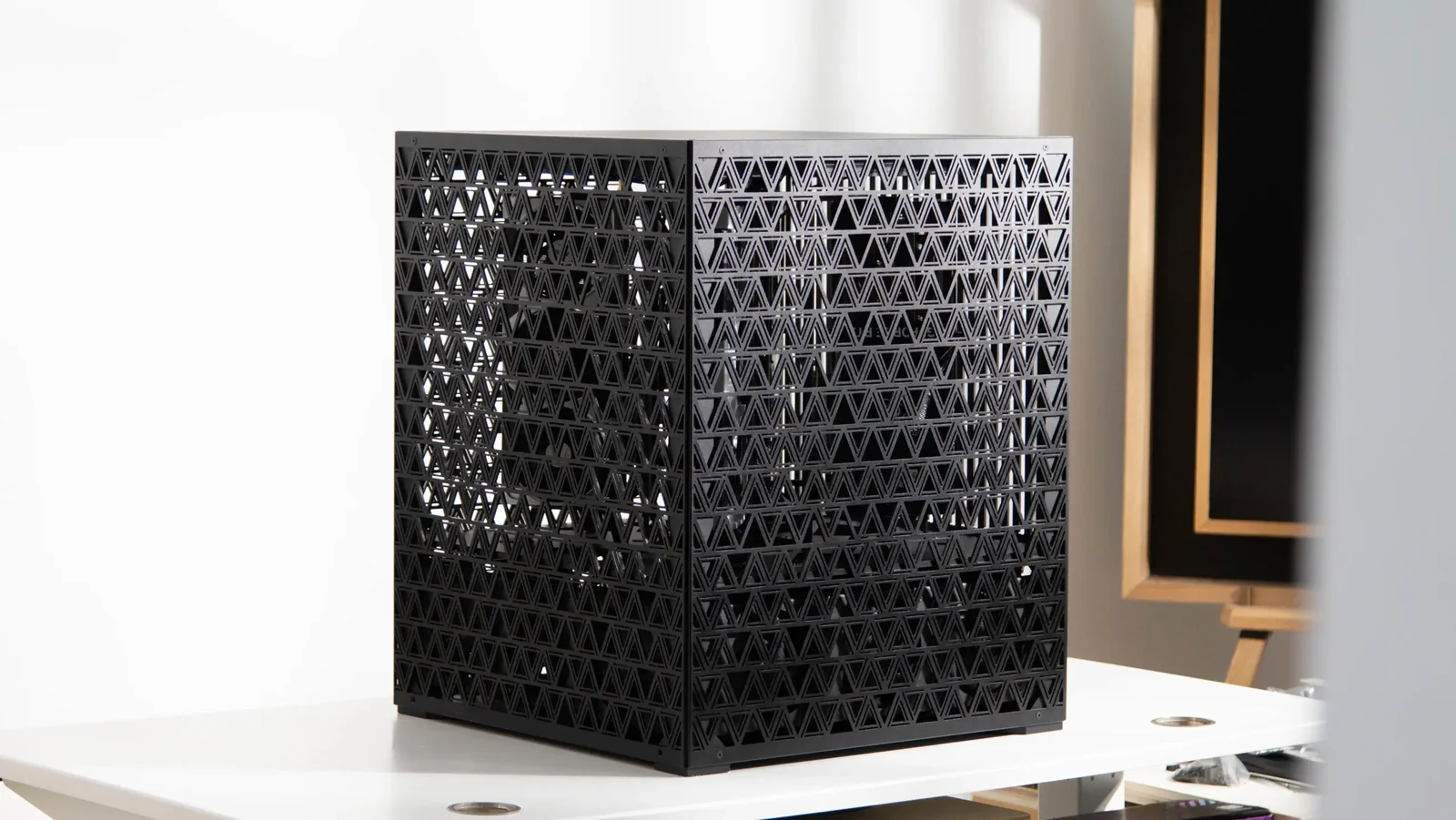
Open-frame four-GPU professional AI workstation concept with stacked graphics cards, exposed motherboard, and a lower cooling plenum with three fans. Enclosed black cube concept for the four-GPU professional AI workstation, with triangular ventilation openings.

4× NVIDIA RTX PRO 6000 Blackwell

ECC team concept

A high-memory team node intended for larger models, fine-tuning experiments, and shared professional workloads.

Installed GPU memory
384 GB GDDR7 ECC
Nominal aggregate bandwidth
About 7.2 TB/s
Draft host
Xeon W5-3423 · ASUS Pro WS W790E-SAGE SE
System memory / storage
192 GB DDR5 ECC · 2 TB NVMe
Draft power
2× 2,000 W · 240 V concept
Concept envelope
19.8 × 19.8 × 24.2 in · 66 lb

The original sheet proposes seven-slot PCIe lane availability and native 12V-2×6 power. A licensed electrical professional and qualified system engineer must validate the final power, cabling, heat rejection, and circuit design.

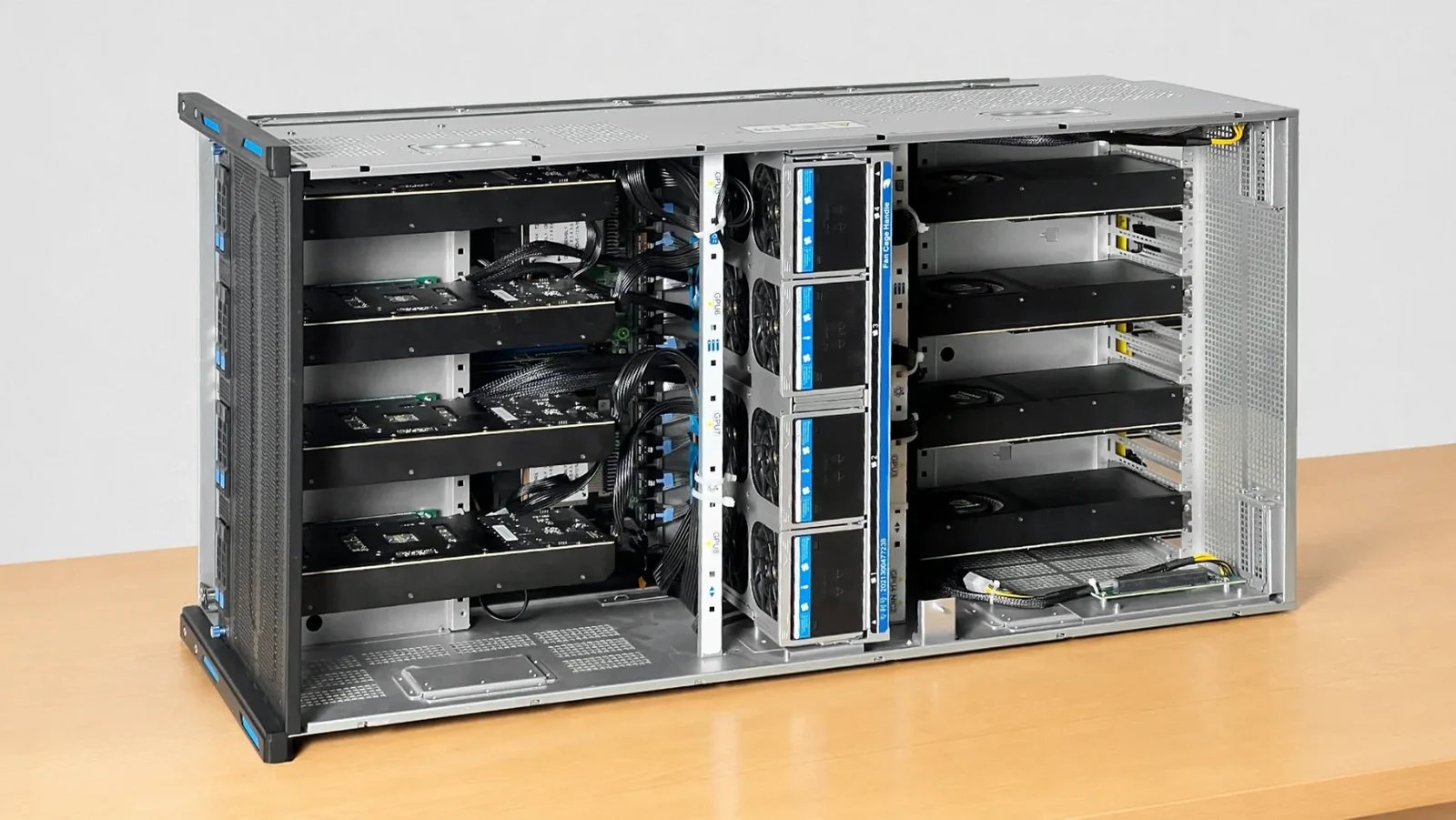
Open-frame concept for an eight-GPU RTX 5090 personal AI datacenter, with vertically arranged graphics cards and a lower cooling plenum. Open five-rack-unit concept chassis containing two banks of four GPUs and central high-speed interconnect cabling.

8× NVIDIA GeForce RTX 5090

Rack / on-prem concept

The largest design in the original set: a proposed on-premises node for developing, serving, and experimenting with open models.

Installed GPU memory
256 GB GDDR7
Nominal aggregate bandwidth
14,336 GB/s
Draft host
2× AMD EPYC 9004 · ASRock Rack GENOA2D24G-2L+
System memory / storage
192 GB RAM · 1 TB NVMe
Draft fabric
PCIe Gen 5 via MCIO · BMC
Concept envelope
5U · 5,100 W estimated draw · 8,000 W PSU concept

This is a datacenter-class engineering problem despite the “personal” ownership thesis. Rack, power distribution, cooling, fire safety, acoustic load, networking, maintainability, and component certification require professional design.

Before any purchase or build

Turn the concept into an engineered bill of materials

1. Workload and model fit

Name the models, quantization, context, concurrency, latency, and fine-tuning requirements. More GPUs are not automatically useful.

2. GPU edition and topology

Fix the exact card, cooling edition, slot width, PCIe lane map, riser/MCIO design, and software’s multi-GPU behavior.

3. Power and electrical safety

Engineer sustained and transient load, PSU derating, connectors, branch circuits, PDU, grounding, UPS, and emergency shutdown.

4. Thermal and acoustic design

Model airflow, heat rejection, ambient limits, recirculation, fan curves, noise, dust, maintenance access, and component temperatures.

5. Chassis and structural design

Validate clearances, brackets, cable bend radius, rack loading, center of gravity, vibration, serviceability, and fire-safe materials.

6. Governance and data boundary

Local ownership does not automatically create privacy, security, clinical validity, HIPAA compliance, or institutional authorization. Personal and Community Nurse AI OS remain no-PHI and nonclinical.

Manufacturer references

Verify the cards before engineering around them

The concept drawings are Robert Domondon’s design portfolio. Manufacturer pages are linked only to verify current GPU-level specifications; they do not validate these multi-GPU systems.

Review practical hardware tiers → Return to Local & Sovereign Systems